
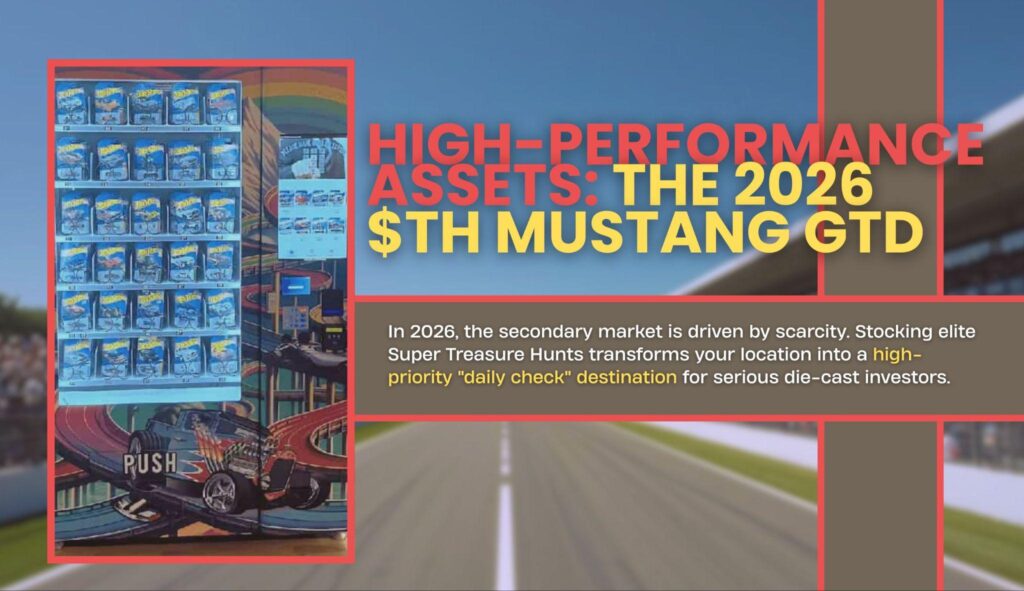
In the competitive landscape of the 2026 die-cast market, the traditional retail model of “fill and forget” has become obsolete. For high-volume vending operators and serious investors, the revenue generated from a standard mainline car is merely the baseline; the true profit and sustained traffic are driven by the strategic placement of chase variants. As we navigate this year’s release cycle, the secondary market has placed a staggering premium on specific models, turning a standard transaction into a high-stakes hunt. Entrepreneurs are increasingly realizing that Hot Wheels vending machines serve as the most efficient delivery system for these rare finds, allowing operators to capitalize on “Treasure Hunt” (TH) and “Super Treasure Hunt” (STH) demand without the overhead of a traditional storefront. By stocking these elusive cars, an operator transforms a machine from a simple vendor into a daily destination for a dedicated community of local “hunters.”
Understanding the nuances of the 2026 chase series is essential for anyone looking to maximize their return on investment in the collectible space.
The Anatomy of the 2026 Chase Market
In 2026, the distinction between a standard mainline and a Super Treasure Hunt has never been more lucrative. While a regular mainline might sell for a healthy margin, an STH variant—characterized by its Spectraflame paint, Real Riders rubber tires, and the discrete “TH” logo—can immediately command 20 to 50 times its retail price on secondary platforms.
For the first half of 2026, the market has identified several “blue chip” models that drive exceptional foot traffic. The 2026 Ford Mustang GTD Super Treasure Hunt has emerged as the definitive chase of the season. Clad in a deep, lustrous Spectraflame blue, it represents the intersection of modern automotive engineering and high-tier collectibility. Other significant draws include the Ferrari F40 Competizione and the Subaru Impreza WRX STH, both of which have seen secondary market valuations climb into the hundreds of dollars within weeks of their release. For a vending operator, these aren’t just toys; they are high-performing assets that ensure the machine remains relevant in a fast-moving economy.
Driving Repeat Traffic Through “The Chase”
The primary challenge of automated retail in a mall or high-traffic venue is “audience fatigue.” If the local population sees the same 72 cars every time they walk by, the sales velocity inevitably drops. Stocking rare chase cars solves this problem by creating a “revolving door” of serious collectors.
Serious die-cast investors are known for their discipline. They often visit specific machine locations daily, sometimes twice a day, to check if a fresh case has been loaded. By ensuring that a “Treasure Hunt” or a “Zamac” exclusive is periodically mixed into the coils, an operator creates a sense of “Impulse Momentum.” Even if a collector does not find the specific STH they are looking for, the act of checking the machine often leads to a “consolation purchase” of a standard licensed model or a “New for 2026” casting. This repeat traffic is the lifeblood of a high-volume route, keeping the turnover rate high and the inventory fresh.
The ROI of Curation vs. General Stock
While general stock boxes provide the volume, “curated” stock is where the professional operator finds their highest net margins. A standard 1:64 car might net a modest profit, but a Treasure Hunt like the 1992 Dodge Viper RT/10 or the white-and-green ’87 Buick Regal GNX can be priced strategically to reflect its rarity.
Professional operators in 2026 often use a “hybrid” stocking strategy:
- The Foundation: 80% of the machine is filled with high-velocity licensed models—Lamborghinis, Porsches, and Nissans—that appeal to casual shoppers and children.
- The Bait: 15% is dedicated to regular Treasure Hunts and “store exclusives” (like Zamac or Red Edition cars) that attract intermediate collectors.
- The Prize: 5% is reserved for the Super Treasure Hunts. These are often displayed in the most visible coils or featured on the machine’s digital playback screen to signal to the community that “The Big One” is available.
This strategy ensures that the machine appeals to every level of the market, from the parent buying a quick gift to the die-hard investor willing to spend significant sums for a “short card” STH.
Image from Pexels
Managing the Secondary Market Ripple
The secondary market in 2026 is hyper-connected. When a collector pulls a rare find from a vending machine, they often post it immediately to local Discord groups or Instagram. This creates a “ripple effect” that drives a surge of traffic to that specific machine location.
Smart operators monitor these social signals. If they notice a high volume of “unboxing” posts from a specific mall, they know it is time to restock that unit with fresh “chase” potential. This real-time responsiveness allows an operator to act as their own marketing agency, using the collector community’s passion to drive their own sales velocity. The transparency of the secondary market ensures that rare items are valued correctly, allowing the operator to justify a premium price point for specialized inventory.
Operational Efficiency: Culling the “Shelfware”
One of the hidden costs of die-cast vending is “shelfware”—fictional or non-licensed castings that simply do not move. In a traditional store, these cars sit on the pegs for months. In a vending machine, they take up valuable real-time real estate.
The professional operator uses their backend analytics to identify these slow-movers and replaces them with cars that have a higher “trade-in” value. In 2026, licensed “Tuners” (Japanese Imports), “Trucks,” and “Euro” wagons are the dominant performers. By focusing the inventory on these high-demand categories and sprinkling in the “Treasure Hunts,” the operator ensures that the machine’s “Inventory IQ” remains high. Every coil that is not turning over at least once every three days is a coil that should be re-evaluated.
The Future of High-Value Die-Cast Vending
As we look toward the latter half of 2026, the integration of digital and physical collecting will only intensify. We are already seeing machines that offer “digital twins” or NFT-linked authentication for Super Treasure Hunts, providing a secondary layer of security for the buyer.
For the high-volume operator, the goal is to remain the most reliable source for these high-value assets. Whether it is the hunt for the latest Porsche 911 Carrera RS 2.7 or the pursuit of the elusive “Drift Ender” chase, the machine is the modern-day treasure chest. By understanding the math of the “chase” and staying attuned to the shifting trends of the collector community, an operator can build a resilient, high-margin business that thrives on the thrill of the find.
Final Thoughts
Stocking rare Treasure Hunts is not just a stocking tactic; it is a business philosophy. It requires a deep knowledge of the 2026 release calendar, a keen eye for secondary market valuations, and the operational agility to pivot when a new “viral” car hits the scene.
In a world where traditional retail is struggling, the specialized vending model is flourishing. By providing the “Big Prize”—the STH Ford Mustang or the Ferrari F40—you are giving your customers a reason to return to your machine every single day. The high-stakes business of 2026 die-cast is about more than just selling cars; it is about providing the excitement of the hunt. For the operator who can master the art of the “Chase,” the rewards are as significant as the cars themselves. Keep your coils full, your analytics sharp, and your “Baits” high-value, and the collectors will ensure your machine remains a gold mine.